


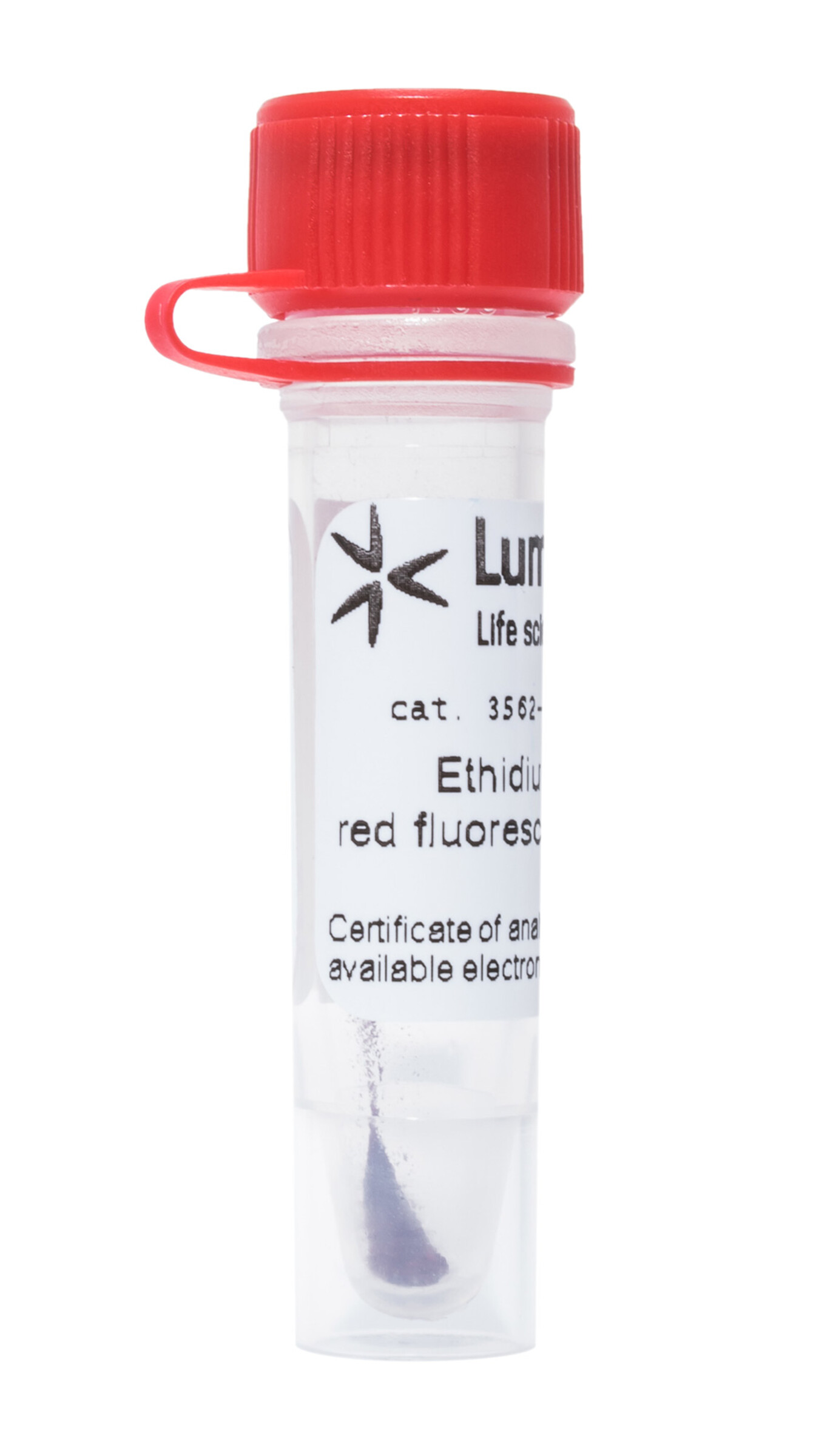
Ethidium homodimer 1, red fluorescent nucleic acid stain
| Artikel-Nr. | Packungseinheit | Preis | Vorlaufzeit | Jetzt kaufen |
|---|---|---|---|---|
| 3562-1mg | 1 mg |
$172.00
|
Auf Lager |


Ethidium Homodimer 1 (EthD-1) is a high-affinity, red fluorescent nucleic acid dye impermeant to live cells and widely used to identify dead cells in biological research.
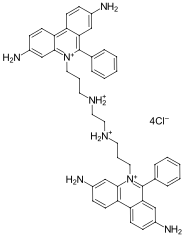
EthD-1 is a dimeric analog of ethidium bromide, consisting of two ethidium moieties linked by a rigid bridge. Due to its large size and charged (dicationic) structure, EthD-1 cannot enter living cells with healthy membranes. In cells with compromised membrane integrity (dead or late-stage apoptotic cells), EthD-1 passively enters the cytoplasm and nucleus, where it intercalates into double-stranded nucleic acids (DNA and RNA) and exhibits a massive fluorescence enhancement (>40-fold) upon binding.
The EthD-1 red emission is easily distinguishable from green fluorescent probes (e.g., GFP, FITC, Calcein, LUCS® 9, LUCS® 13), blue Hoechst stains, and far-red dyes (LDS 751, LUCS® 5), enabling easy multiplexing.
EthD-1 is a standard dead-cell indicator in the viability and cytotoxicity assays, most commonly paired with green fluorescent live-cell stain like Calcein AM, LUCS® 9, or LUCS® 13. It is also used as a counterstain in fluorescence microscopy.
Note that, while highly specific for dead cells in short-term assays, prolonged exposure can lead to its uptake by live cells, as it is mildly cytotoxic and can eventually permeabilize membranes.


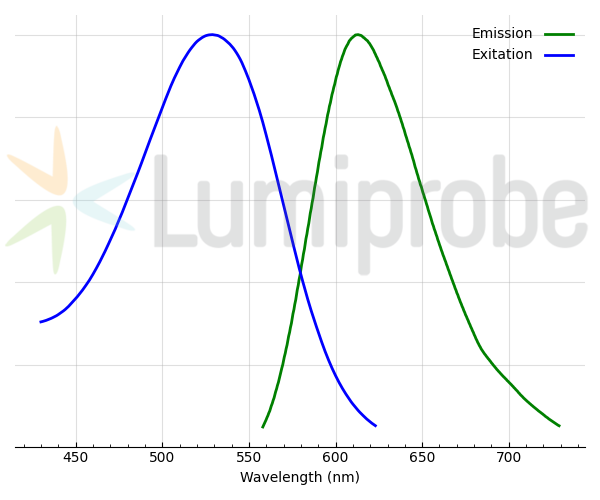
Anregungs- und Emissionsspektren des dsDNA-Komplexes mit Ethidiumhomodimer 1
Kunden kauften zusammen mit diesem Produkt




General properties
| Appearance: | dark red-violet solid |
| Molecular weight: | 856.77 |
| CAS number: | 61926-22-5 |
| Molecular formula: | C46H50Cl4N8 |
| Solubility: | methanol, water, DMSO |
| Quality control: | NMR 1H and HPLC-MS (90+%) |
| Storage conditions: | 24 months after receival at -20°C in the dark. Transportation: at room temperature for up to 3 weeks. Desiccate. |
| Sicherheitsdatenblatt: | herunterladen |
| Product specifications |
Spectral properties
| Excitation/absorption maximum, nm: | 529 |
| Emission maximum, nm: | 613 |


 Ihr Warenkorb ist leer

 $
$